When Expertise Arrives With the Check: The Promise and Peril of Human Capital Philanthropy
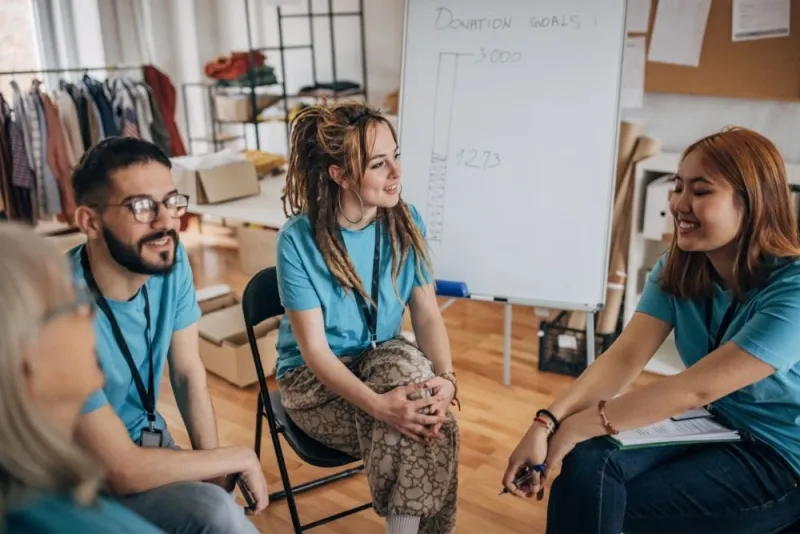
Photo: volunteer professionals meeting with nonprofit staff in community office, via connectivewebdesign.com
The grant agreement arrived on a Tuesday. Along with it came a phone call from the foundation's program officer, who mentioned—almost in passing—that a member of the foundation's own staff would be available, roughly eight hours a month, to help the nonprofit with its financial systems. No charge. No strings. Just a colleague.
For the executive director of the small workforce development nonprofit on the receiving end, the offer landed somewhere between relief and unease. Relief, because her organization had struggled for two years to afford a competent bookkeeper. Unease, because she had heard the stories: foundations whose "support" came to resemble supervision.
Across the country, this tension is playing out in a quiet experiment that industry observers have begun calling human capital philanthropy—the practice of foundations contributing people, not just money, to the organizations they fund.
Beyond the Transactional Grant
Traditional grantmaking has always carried a certain arm's-length formality: an application, a report, a renewal. Human capital grants disrupt that rhythm. They might send a retired CFO to coach a food bank's finance team, embed a communications specialist with a housing coalition, or organize skilled volunteer teams to build out a nonprofit's technology infrastructure.
The rationale is straightforward. Money alone cannot fix what ails many small nonprofits. A rural health clinic might need a reimbursement systems expert more urgently than a one-time cash infusion. A fledgling after-school program might collapse not from lack of funding but from lack of a development plan.
"We were drowning in good intentions and bad spreadsheets," one Midwest nonprofit leader recalls. "The foundation sent us a volunteer who had spent thirty years in municipal finance. She rebuilt our budgeting process in a season. No consultant we could have afforded would have done that."
The Micromanagement Question
Yet the model has its skeptics, and their concerns deserve to be taken seriously. When a foundation's staff member sits inside a grantee's operations, the boundary between funder and funded grows porous. Nonprofit leaders describe moments when advice began to feel like direction—when a suggestion about board governance started to sound like an expectation.
The power asymmetry is unavoidable. A nonprofit that depends on renewal funding cannot easily tell a foundation's emissary that her help is unwelcome. Some executives have learned to nod appreciatively at strategies they privately doubt, knowing their next grant cycle is only months away.
Critics argue that the healthiest human capital grants share three characteristics: the nonprofit chooses whether to accept the expertise, the expertise responds to needs the nonprofit itself has identified, and the foundation's people arrive as learners first—asking what the organization already knows before prescribing what it lacks.
What Both Sides Are Learning
The foundations investing in this approach insist they are recalibrating, not overreaching. Several have adopted formal protocols: staff secondments are voluntary for grantees, coaching engagements have defined endpoints, and funders receive feedback through anonymous channels rather than through the relationship itself.
The nonprofits that report the best outcomes tend to describe the arrangement in a particular way. They do not call it a grant. They call it a partnership. The distinction matters. A grant is consumed; a partnership compounds. Skills transferred into a nonprofit's staff remain long after the funding relationship ends, multiplying the return on every foundation dollar.
There is, finally, a cultural argument for sending people alongside money. Foundations that never leave their own conference rooms tend to develop abstract theories about community need. Staff who spend eight hours a month inside a food pantry's back office come home with different questions—and, often, different convictions about what their institution should fund next.
The pastor who shows up with the check, in other words, may be changed by the visit as much as the congregation is. In a sector searching for models of genuine reciprocity, that may be the most valuable return of all.